Originally published on LinkedIn
Quantum in an era of rapid change (NYC Quantum Summit 2026)
Oct 8, 2026 | Charles Tahan
This is an archived copy of a LinkedIn post. The original is at the link above.
I always enjoy attending the NYC Quantum Summit (https://physics.nyu.edu/nycquantum/). I learn a lot and meet interesting people. Thank you Javad Shabani, Juan J. de Pablo, and New York University for hosting us all again. It is great seeing what the NY ecosystem is building in quantum.
This year I talked about the immense moment we are living in as scientists: as AI revolutionizes not only how science is done but what it means to be a scientist - and what Microsoft Discovery + Quantum is doing about it, along with what we are building in Microsoft quantum and Maryland/DC.
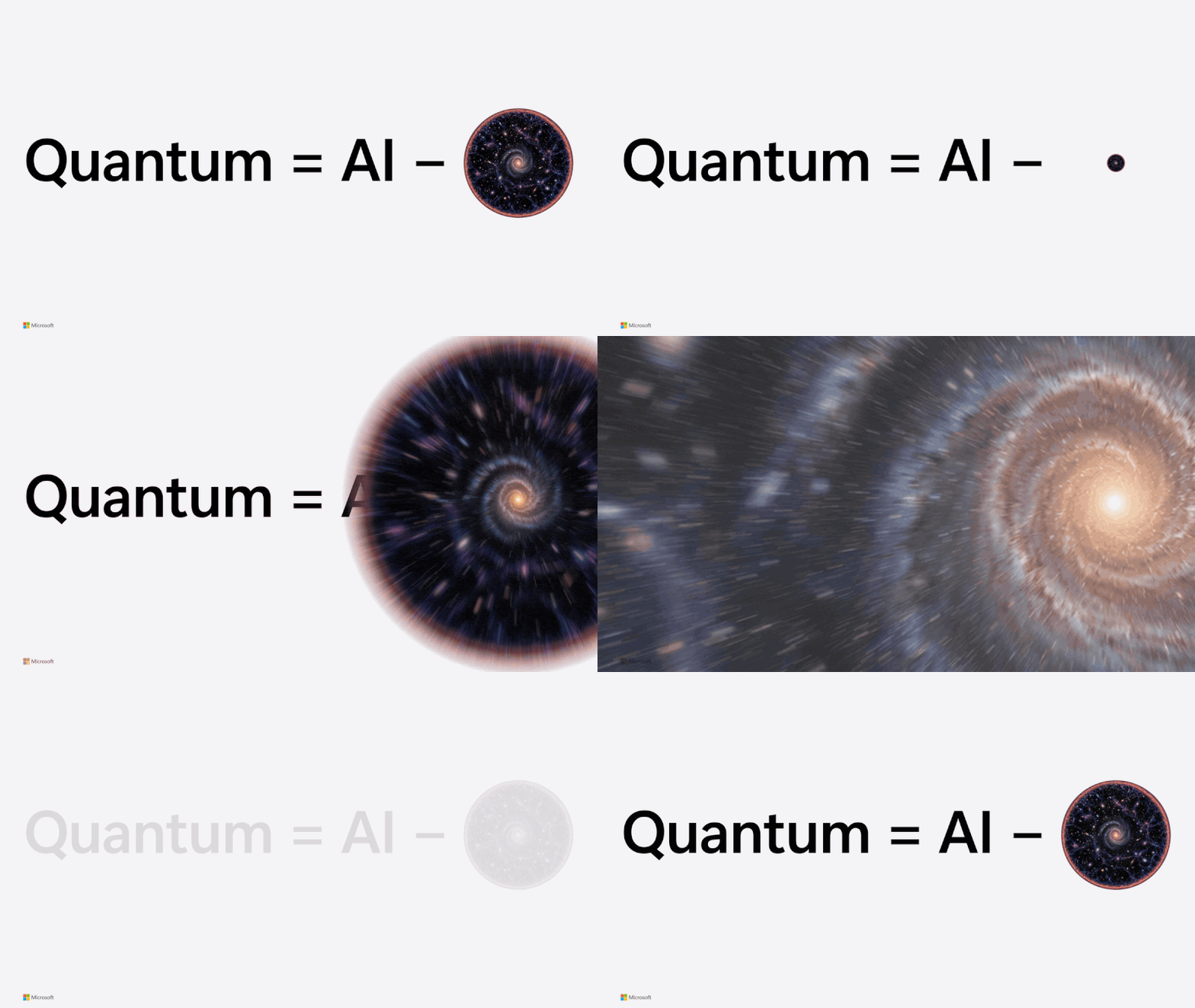
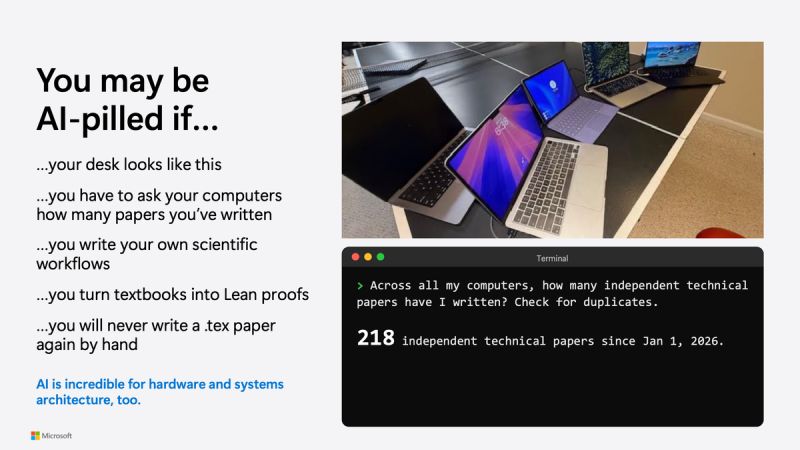
I attached the two fun slides below. I argued that Quantum is “AI minus the universe”. AI will eat the world (as people used to say about software, I hope not literally). But the operating system of the universe is quantum mechanics, and AI will need quantum computers to understand it. (I made that case here as well: https://arxiv.org/abs/2412.18726). I also talked a little about my own journey these last 6 months applying AI (see, e.g., the Discovery app, a harness for science Microsoft is building: https://azure.microsoft.com/en-us/solutions/discovery) to the problems I care about. People don’t believe me when I say I’ve “written” hundreds of technical papers so far…so I asked my computers to count them up… I’m honestly not sure what to do with them. Time is going so quickly. We are having a “Quantum Vibeshop” at the APS Global Physics Summit to talk about this. I should write more as I now see many colleagues starting to get AI-pilled themselves.
It’s a timely day to give such a talk as the experimental realization of our first “AI accelerated” project just came out: https://arxiv.org/abs/2610.07393. This is a fun one, one of those ideas you keep in your notebook for a long time for whenever you find time or a student to work on it. Now AI can make those just happen, or at least get you started faster. The question is whether an array of spins in the S=0 manifold (that is, not quite full qubits) can do anything useful. It turns out they can. They are great for early benchmarking on the path to a fault tolerant QC, and perhaps for simulation of novel systems in the quantum advantage regime, and more. I’m grateful for the collaboration with HRL Laboratories, LLC to make this happen together and to my colleagues at Microsoft, Silas Hoffman, Edward Chen, Matthew Brooks along with Stephen Carr, Jacob Blumoff, Thaddeus Ladd, and many more at HRL who helped de-slop the early ideas and then implement them at unbelievable speed (see the prior theory paper we wrote together: https://arxiv.org/abs/2607.06672). Beautiful experimental data. I started working on spin qubits in 2001 - it only took 25 years guys!
It only gets faster from here.